


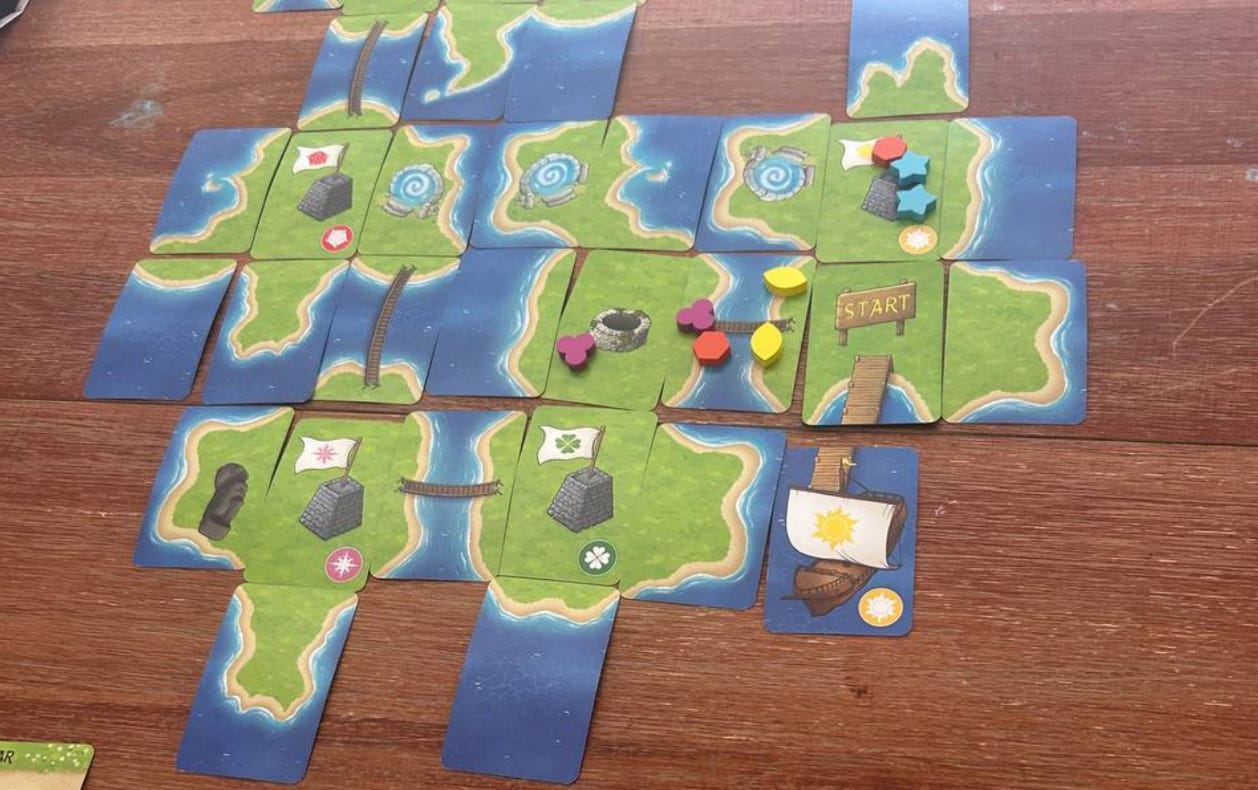
Seven Islands, the new game by Andy Looney, was just released at the end of June.
How do I describe this game? What do I think about it?
I was able to playtest this game with my friend Fodkam in person at the Looney Lab headquarters (at the Sterling Building) in College Park, Maryland, back in February.
It has come to my attention that the ‘90s alt-rock band Velocity Girl’s biggest hit was “Crazy Town,” which can be seen as a tribute to their hometown of College Park. I can only imagine this song is contemplating the work of Andy Looney and his existence in such a crazy town. The borough that they live in is called “Hollywood.” So it becomes a witty joke that Looney can say, “we are big stars in Hollywood!”
The Looneys (both Andy and his wife Kristin) live in a purple house called “Wunderland” (or “Wunderland Earth”), where “the offices of Looney Labs are located, and where a weekly, invitation-only Gaming Salon is held.”1 There is another house called “Pepperland,” which was given to a family member, but we didn’t stay there. I was able to pick up the Looneys from the outside of Wunderland and bring them back to the Sterling building, where I would playtest Seven Islands with Fodkam.

For at least four months, I could not share what the game was about until it came out. Now that it is out, I would like to give some art direction input and creative commentary around this eccentric design.
But first, what is this game about and how do you play it?
—
…Seven Islands describes itself as “an island-hopping race of changing goals” on the back of the box. The rules are simply described: “When this ship is docked… …maneuver both of your pieces… …onto this Beacon to win the game!”
Or, as the story is written in the rules:
“You and a friend are contestants on a reality show! You’ve been stranded on a tiny tropical island, which is connected to six others by rickety bridges that have yet to be located. The first team to reach the designated beacon wins a million bucks! How do you know which beacon to go to? Just look at the sail on the ship currently docked. Better get there quick before a different ship comes in!”
The game is made up of 81 cards and four sets of two colored player pieces (that being red, yellow, blue, and purple). Two of the cards are not in the deck. One card is the double-faced dock “start” card, and the other is a reference card for all players to share. That makes the rest of the game a deck of 79 cards.
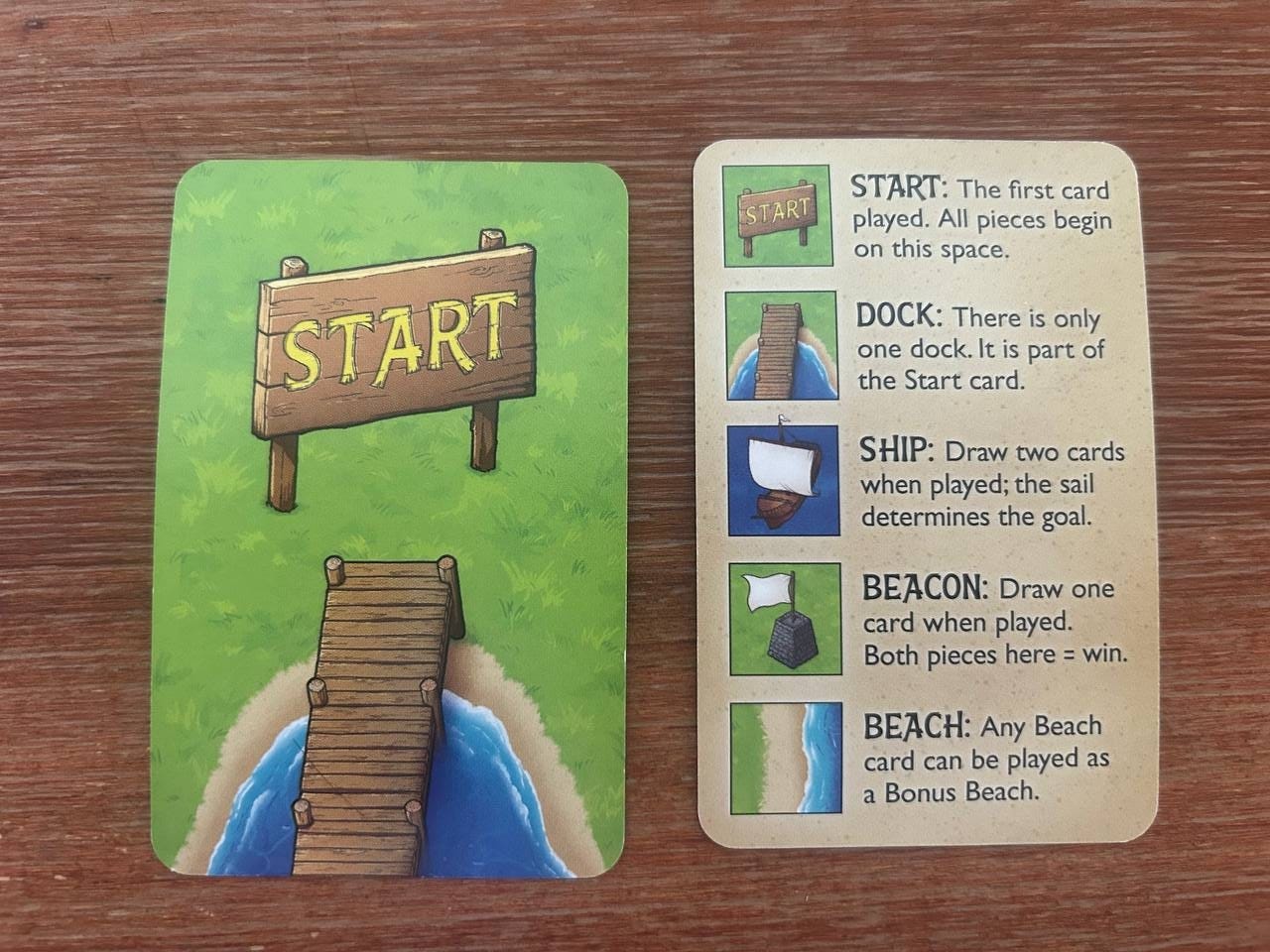
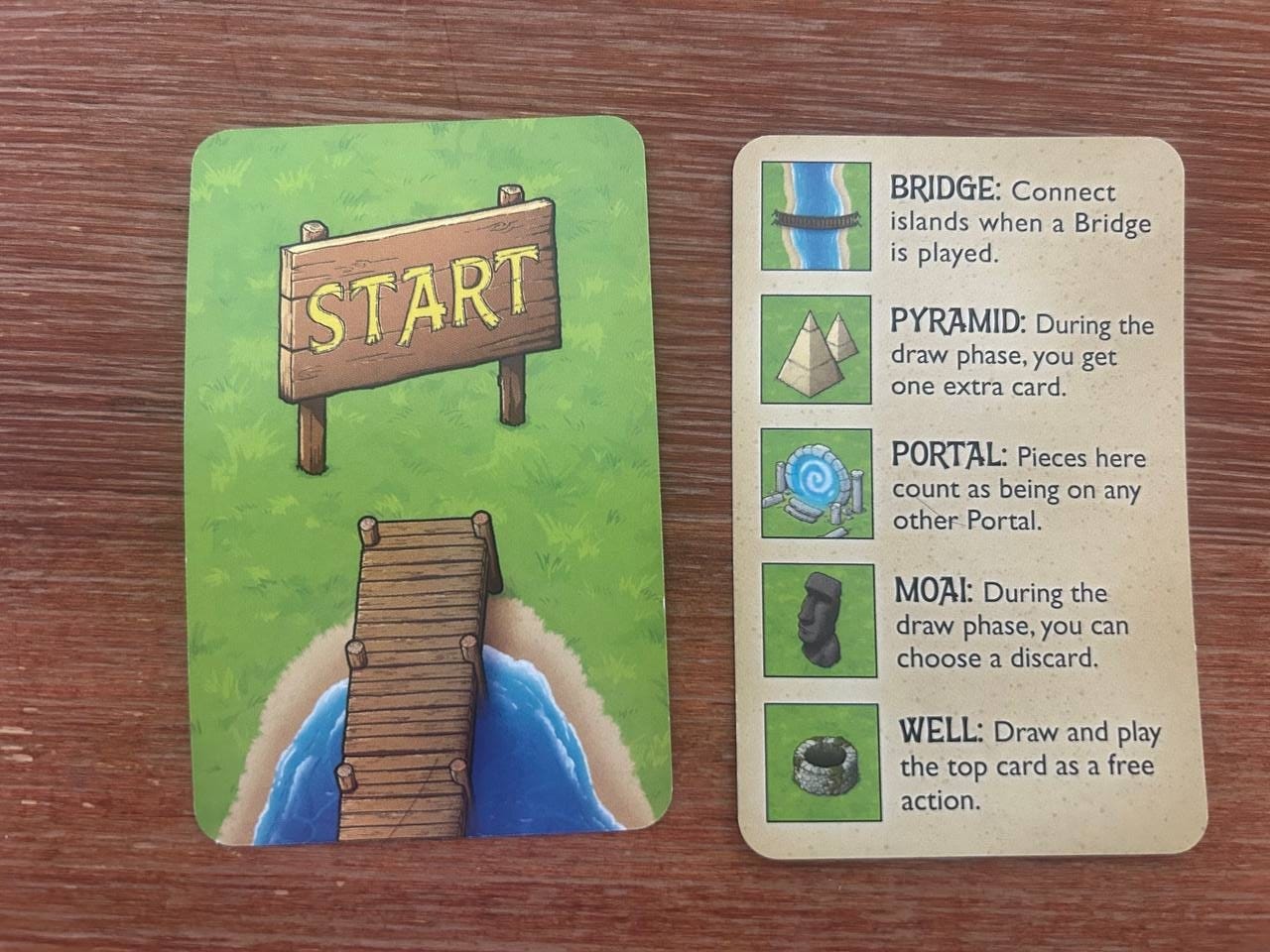
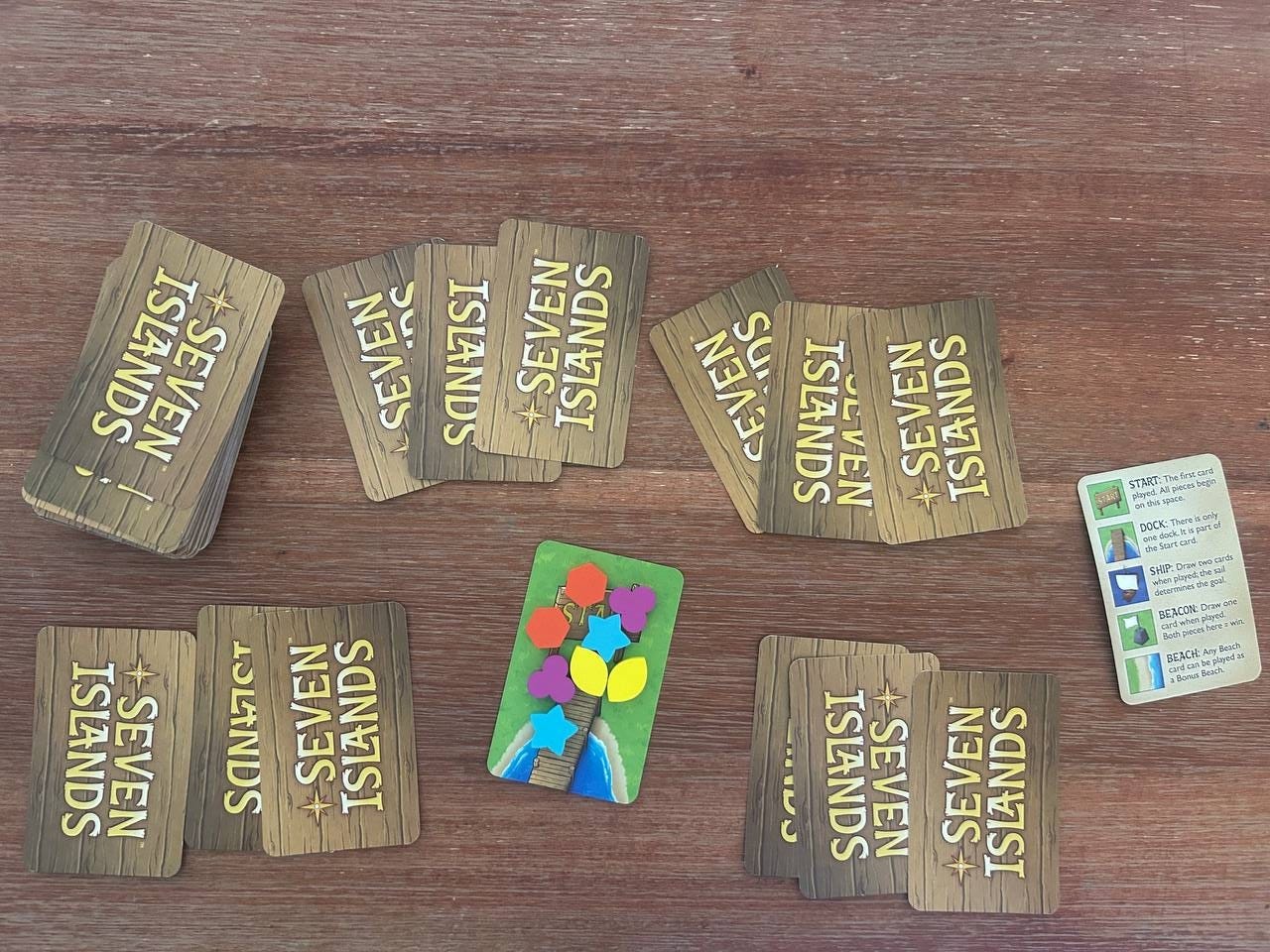
The rest of the cards are shuffled, and three cards are dealt to each player. All players’ pieces are on the “start” dock card, and a shuffled deck is on the side (the discard is there with no cards).
The object of the game is to get both your player colors to a matching beacon card that matches the ship currently docked at the start card. Once both pieces are on a matching beacon and ship card, the game is immediately over, and that player has won (although there can be ties in rare circumstances).
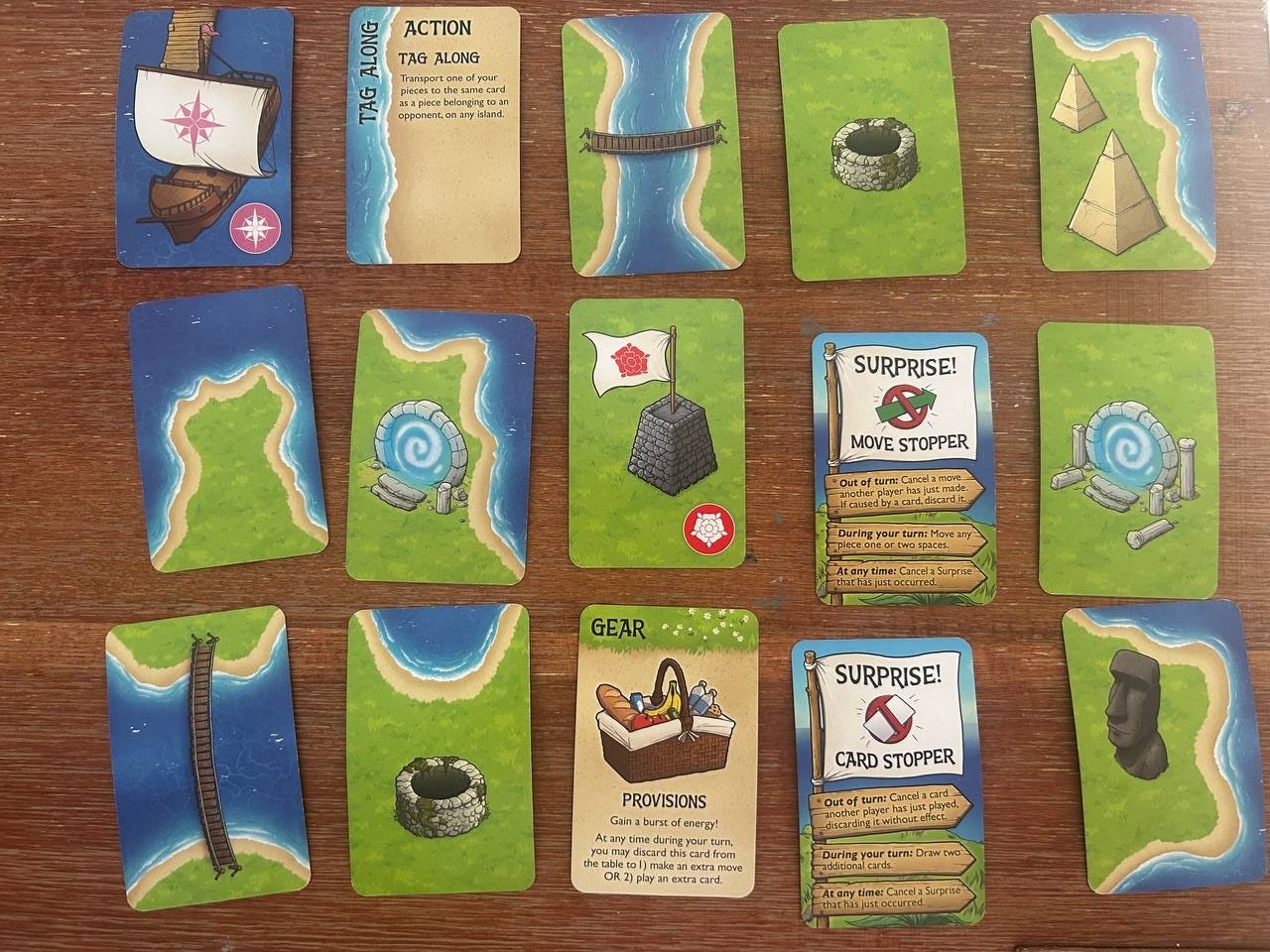
There are four types of cards in the game: terrain, action, gear, and surprise cards. The deck is made up mostly of terrain cards.
Terrain cards can have land, water, beach, and location subtypes printed on them. The locations each have a special ability if a player lands their piece on them, which they can either trigger or has to always happen.
If a beacon is played, the player draws one card, and if a ship is played, the player draws two cards.
The hand limit is 7, and a player discards down at the end of the turn.
Action cards are only played on that player’s turn, and the action is executed on the card.
Gear cards are played in front of that player’s tableau, and the player currently owns that ability written on the card (either as a trigger ability or constant). A player is allowed a gear limit of 3.
Surprise cards are the only cards that can be played out of turn, preventing another player from doing something. There are only two Surprise cards in the entire deck. If played on the turn, it is counted as an action for the draw bonus, and is not a free one.
On a player’s turn, they follow this turn structure:
Draw Phase (draw a card)
Action Phase (play any card)
Move Phase (a player may move one of their pieces orthogonally)
Discard Phase (draw down to their hand and gear limit, and pass turn)
“Free Actions” may be spent before or after any phase in any order once per turn. Those three free actions are:
Play another Terrain card that has a beach subtype
Trigger a Gear ability you own
Use the Well location action if your piece is on that terrain card
Whenever a card’s text directly contradicts the game’s rules, the card takes precedence and overrides it.
The only other minor rule is that when a player is on a ship, they may use the move action to move to another beach and discard that ship that was used on the dock (and all players on that ship move too).
Terrain cards have their placement rules, but it’s not that hard to understand once it’s implemented. They only abide by no water-only plays, no beachless edges, and no blocking a beacon to the island. Everything is connected by a beach.
And only one island has one beacon at a time. A player may play a terrain card where there is no connection, but it “floats” until a spot is shown where it can connect. All backed-up “floaters” must connect if there is an immediate available spot, or they keep floating till a spot opens. The active player gets to decide where the floaters go.
The requirement is that every island have a beacon, or the ability to add a beacon… but there’s no requirement that it have either a bridge or portal, as there are other ways to travel there: by ship, action cards or gear abilities. So it’s not necessary to have multiple other terrain cards float waiting for a portal or bridges attachment. Islands can be quickly enclosed or created by floaters without portals or bridges in their existence, so as long as those islands have at least one beacon on them.
There are only 18 action cards and 8 gear cards, each being unique and never duplicating. There are also only 6 bridge cards, so each has to be played accordingly to shape the island, for good or for worse.
There are 11 terrain cards with locations on them, and 16 terrain cards with no locations. These are also evenly matched with 7 beacons and 7 ships to dock. Ideally, it is better to have terrain cards with locations on them, but there is no telling what a player can draw.
I have made some impressive and imaginary maps with this single deck of cards. This is where the formation of the map reminds me of something out of Chip’s Challenge or Toejam & Earl. Both of these games rely on a top-down and grid-like perspective, perhaps rogue-like land generation and displaced puzzles, such as “the red key opens the red door,” for the game to operate. Seven Islands takes these two concepts of improvisation and planning and transforms them into the closest thing to an exploration card game.
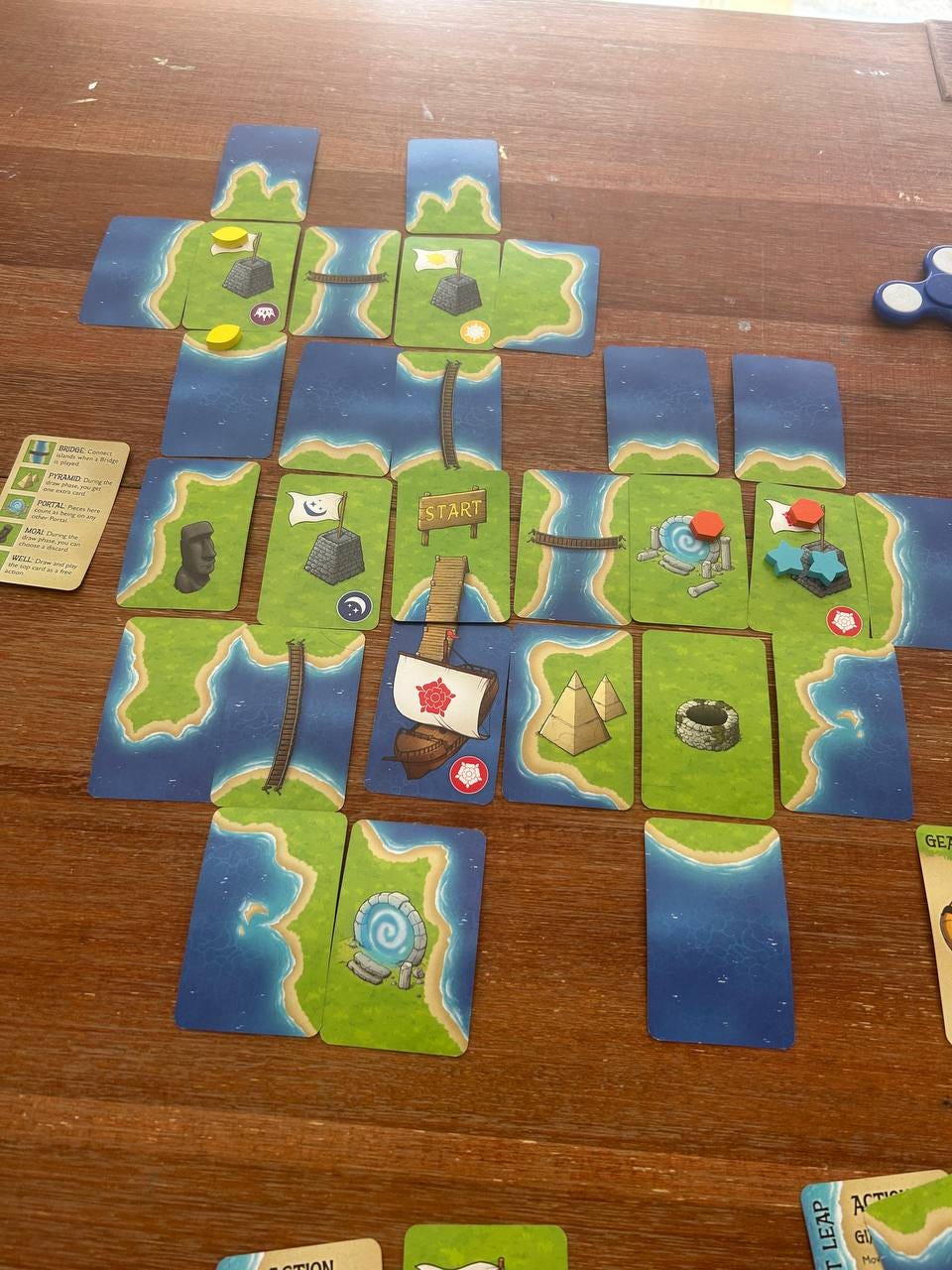
When I play by myself and finish the game, I like to get the extra terrain cards from the deck and discard pile, and then try to finish the island as intended.
With the basics of the game being explained, what I really wanted to write about was my thoughts behind the design process and what I see missing from most board and card games in 2026. (Or, what I also see missing from original art and design in general, actually…)
—
…Seven Islands belongs in a category of physical games where true interactivity is needed. This isn’t with artificial intelligence. It’s with real human beings with emotions and expression that feel their own actions and influence one another.
The game is modular. It’s meant to be expanded, taken apart, or completely rewritten with a new ruleset using the same system.
I enjoy “object-oriented” computer programming languages such as Max, AudioMulch, Reflection, Bidule, Pure Data, and anything that resembles a Eurorack system. One “module” can be a card, and that can influence an entire path of other modules that represent themselves. It creates an environment where play is encouraged, and expression is the art. The player commits his time and invests his effort to make the game into a sport. It’s the same as reading a book of philosophy and dedicating your life to the craft. A good game gives you that feeling, but a great game is that lifetime art.
I looked at the deck of cards, and honestly, I feel like it could use some more teleporter subtypes. If I bought two more copies of Seven Islands, I could add in a couple more terrain cards with well subtypes, and add additional surprise cards to give it that “take that” randomness. And why not get rid of some beacons and make the game more about exploration with a very large map! I hope Looney considers making an expansion or releasing some promo cards to give more “modules” to the game’s programming language.
The size is important too. While games like Cosmic Encounter require a whole table or space on the floor, Seven Islands can fit in a bookbag or pocket. This design is intentional because most Americans can not find the room or time to even play a game with someone else. I could argue that this strategy to get the attention of new players implies “elegance,” but I have argued against that elsewhere.2 The modules create rules and contradictions that allow full expression rather than that of a Rubik’s Cube solving itself. While it may look like another eurogame with a selfish “window shopping” interface and personal tableau, the game influences other players through action cards and abilities. Timing is key. The bluff is when you are ready to play a beacon or hold on to the ship card. Many players see the map for what it is and use deduction to figure out how many bridges are left and what moves can be played before the match is made.
I would like to see more expansions released for this game. Or, I would like to experiment with multiple copies and try to make my own personal deck of cards. It would be nice if different expansions could be bought for different island formations and actions.
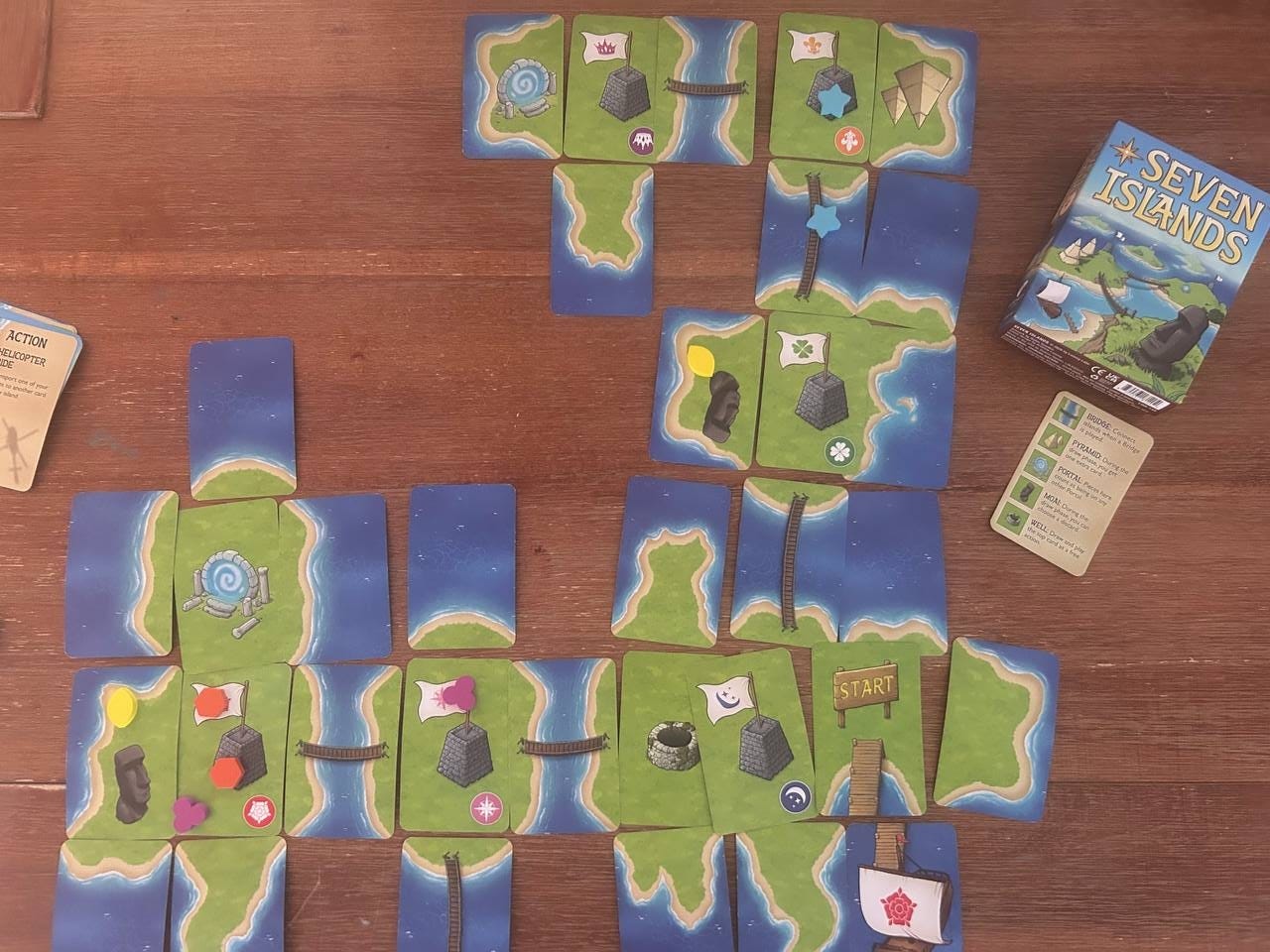
Once again, Looney has proved something with his designs that show throughout all of his games. He is interested in the modular and encourages players to be their own programmers to express themselves in the game environment. His games could easily be played for a lifetime, and one person could immediately say to someone, “I only play Seven Islands, and I go to my weekly Seven Islands club.”
Every time he releases a game, it is an exciting event where something new in design is introduced. I call this phenomenon “post-elegance” due to its lucid nature, returning to real player interactions and modules that express the environment and influence. Finally, the post-elegant game makes a return to the player as an artist. One such canvas is Seven Islands.

-pe
the 6th of August, 2026.
See my thesis, “Post-Elegance: Experimental Aesthetics In Tabletop Game Design.”